Thursday, March 29, 2007
Languages - A Star Trek-like Journey?
No matter how wonderful we may be as teachers – and no matter what fabulous techniques we have learned and tweaked and refined – chances are, our students won’t really be learning Spanish (or any other language) unless they want to learn it.
We might be teaching them, yes, and they might also be performing well – and of course, our skills are crucial here – but are they really learning? And even more important, are they craving more?
Are they becoming lifelong learners who want to embark on a Star Trek-like journey to seek out new contacts in the language and culture?
Do they tune the radio to the Spanish station when they’re in the car? Do they switch to a Spanish program on their televisions at some point during the day? Do they have French, Italian, German, Chinese, Russian or Japanese popular music on their iPods? Do they make an effort to greet and converse with native speakers in their town? Do they see themselves visiting the countries where the language they're studying is spoken?
Do they see that languages all around them and can enrich their lives and their experiences every day?
Our goal as teachers is to spark that motivation in our students.
But how do we get there?
We need to take language study out of the classroom and into real life, and we need to bring real life into the language classroom. That's the motivation behind Chispa.
It's a journey well worth taking, for all of us. And it's not just worthwhile – it's fun!


Thursday, March 15, 2007
Pasos de gigante -- but forwards or backwards?
I just got this email from a friend, under the heading "increíble."
"Ruth, acabo de escuchar esta noticia. Una emisora de radio tiene un concurso de agarrar a un inmmigrante.
Estoy arrechiiisima!! Echo humos por todas partes. Dios Mio, creo que es como un virus que se está regando. Parece mentira pero como que estamos echando para atrás. Todo lo que habíamos ganado, parece estarse devolviendo a pasos agigantados. Podemos hacer algo al respecto? Lee sobre los imbeciles estos..
"Craig announces that ‘Operation La Cuca Gotcha’ kicks off tomorrow February 6th. Our listeners can help ‘out’ illegal immigrants by any of the following methods:
Calling into the show or our toll free number
Call any immigration office toll free hotlines which are posted on the Jersey Guys webpage
The ultimate Jersey Guys goal is set: 300 illegals in 3 months. Beginning tomorrow February 6th and ending May 5th (yes, Cinco De Mayo). The guys plan on possibly renting a bus and going around and trying to round up illegals by themselves. But how do you keep them from escaping?"
So this is like that ridiculously inflammatory and offensive "Catch an Illegal Immigrant" contest at NYU earlier this year. Only this time, it's for real.
Increíble, yes. I would also call it asqueroso.
But mostly, instead of naming what I feel about it, I have to start thinking about actions I can take to counteract this in a POSITIVE manner. Two negatives may make a positive in math, but they don't in real life.
I definitely feel that that my videos will help, by celebrating the Spanish language and Latino cultures in the United States as valuable and valued resources.
And I know that my writings are on target, too.
But there is so much more to be done, and it is going to require the combined POSITIVE efforts of a whole lot of people to stem this kind of thinking.
We have our challenge, and it's not catching illegal aliens ....
"Ruth, acabo de escuchar esta noticia. Una emisora de radio tiene un concurso de agarrar a un inmmigrante.
Estoy arrechiiisima!! Echo humos por todas partes. Dios Mio, creo que es como un virus que se está regando. Parece mentira pero como que estamos echando para atrás. Todo lo que habíamos ganado, parece estarse devolviendo a pasos agigantados. Podemos hacer algo al respecto? Lee sobre los imbeciles estos..
"Craig announces that ‘Operation La Cuca Gotcha’ kicks off tomorrow February 6th. Our listeners can help ‘out’ illegal immigrants by any of the following methods:
Calling into the show or our toll free number
Call any immigration office toll free hotlines which are posted on the Jersey Guys webpage
The ultimate Jersey Guys goal is set: 300 illegals in 3 months. Beginning tomorrow February 6th and ending May 5th (yes, Cinco De Mayo). The guys plan on possibly renting a bus and going around and trying to round up illegals by themselves. But how do you keep them from escaping?"
So this is like that ridiculously inflammatory and offensive "Catch an Illegal Immigrant" contest at NYU earlier this year. Only this time, it's for real.
Increíble, yes. I would also call it asqueroso.
But mostly, instead of naming what I feel about it, I have to start thinking about actions I can take to counteract this in a POSITIVE manner. Two negatives may make a positive in math, but they don't in real life.
I definitely feel that that my videos will help, by celebrating the Spanish language and Latino cultures in the United States as valuable and valued resources.
And I know that my writings are on target, too.
But there is so much more to be done, and it is going to require the combined POSITIVE efforts of a whole lot of people to stem this kind of thinking.
We have our challenge, and it's not catching illegal aliens ....
Friday, March 09, 2007
Phrases we used to learn in language class
My previous post includes a link to Eddie Izzard's hilarious routine about French phrases he had to memorize in French class that ended up being extremely difficult to work into everyday conversation:
"The mouse is under the table."
"The cat is on the chair."
"The monkey is on the branch."
I still remember the junior high dialogues that the kids in French classes had to memorize .... and I didn't even take French! It's funny, but I just wrote about this in the paper that my friend Liz and I are preparing for the NYU "Beyond Borders" conference on multiculturalism and international education (yes, our abstract was accepted!). And then I opened up my daily digest email from the FL TEACH Foreign Language Teaching Listserve, and found many, many language teachers reminiscing about exactly this same thing: the silly phrases they had to memorize, which got stuck in their heads. Some of them were useful:
"Ojalá que se mejore pronto." (I hope he gets better soon.)
Some were less so ....
... the German equivalent of "I have a plaid bathing suit with a zipper."
... the Hebrew version of "Mother, the cheese is bad."
But I have to say that my favorite phrases from any language book are the ones from the book "Hindi Made Easy", that was given to my father when our family spent a year and a half in India in 1961-62. (He was sent by Columbia Teachers College and USAID to work on a nonformal education project there.) I believe this book was the one given to British soldiers stationed in India.
The two phrases that we will all always remember are:
"Let us set fire to the village."
and
"That man is a horse thief."
(I wish I were kidding about this, but I'm not!)
By the way, if you want to see pictures of a 3-year-old me in India .... click here. The white outfits and colored paints and powders are from the holiday Holi, when everyone dresses up in white and throws paint, colored water, and colored powder on everyone else. As a kid, this was just about the most fun I could ever imagine having! Seeing the Taj Mahal was amazing, too. I was so young at the time (3 and 4), but I definitely remember my friends, the people who worked in our house, my British nursery school, Claridge's swimming pool (where my brother fell in before he knew how to swim, and one of his teachers jumped in, in full sari, to get him out), and the elephant I refused to ride on (much to my father's dismay, since he wanted to get a picture, but I had just seen the elephant eat an entire banana WITHOUT PEELING IT, and that just freaked me out .... ). And I remember - and will never forget - the incredible poverty that was around us every day.
"The mouse is under the table."
"The cat is on the chair."
"The monkey is on the branch."
I still remember the junior high dialogues that the kids in French classes had to memorize .... and I didn't even take French! It's funny, but I just wrote about this in the paper that my friend Liz and I are preparing for the NYU "Beyond Borders" conference on multiculturalism and international education (yes, our abstract was accepted!). And then I opened up my daily digest email from the FL TEACH Foreign Language Teaching Listserve, and found many, many language teachers reminiscing about exactly this same thing: the silly phrases they had to memorize, which got stuck in their heads. Some of them were useful:
"Ojalá que se mejore pronto." (I hope he gets better soon.)
Some were less so ....
... the German equivalent of "I have a plaid bathing suit with a zipper."
... the Hebrew version of "Mother, the cheese is bad."
But I have to say that my favorite phrases from any language book are the ones from the book "Hindi Made Easy", that was given to my father when our family spent a year and a half in India in 1961-62. (He was sent by Columbia Teachers College and USAID to work on a nonformal education project there.) I believe this book was the one given to British soldiers stationed in India.
The two phrases that we will all always remember are:
"Let us set fire to the village."
and
"That man is a horse thief."
(I wish I were kidding about this, but I'm not!)
By the way, if you want to see pictures of a 3-year-old me in India .... click here. The white outfits and colored paints and powders are from the holiday Holi, when everyone dresses up in white and throws paint, colored water, and colored powder on everyone else. As a kid, this was just about the most fun I could ever imagine having! Seeing the Taj Mahal was amazing, too. I was so young at the time (3 and 4), but I definitely remember my friends, the people who worked in our house, my British nursery school, Claridge's swimming pool (where my brother fell in before he knew how to swim, and one of his teachers jumped in, in full sari, to get him out), and the elephant I refused to ride on (much to my father's dismay, since he wanted to get a picture, but I had just seen the elephant eat an entire banana WITHOUT PEELING IT, and that just freaked me out .... ). And I remember - and will never forget - the incredible poverty that was around us every day.
Thursday, March 08, 2007
I've been tagged! Why I Blog ....
Normally I hate any type of "chain" letter, but this is different .... Nancy Marmolejo of Comadre Coaching and The Loca Diaries has tagged a bunch of us with the question,
Why Do I Blog?
Well.
I think I blog so that I can share information with people. I am a compulsive resource sharer. Especially if it's (a) related to language and culture and (b) either inspirational or funny.
I mean, where else would I have an opportunity to share this with the world?
Enjoy!
Why Do I Blog?
Well.
I think I blog so that I can share information with people. I am a compulsive resource sharer. Especially if it's (a) related to language and culture and (b) either inspirational or funny.
I mean, where else would I have an opportunity to share this with the world?
Enjoy!
Friday, February 16, 2007
Bilingual babies

This is what my friend's bilingual six-year-old asked, when she heard about a new baby cousin in the family:
"Salió en inglés o en español?"
("Did the baby come out in English or in Spanish?")
Wednesday, February 07, 2007
¡¡PBS en español!!
Great news for the entire Spanish-speaking and bilingual community of the United States, as well as Latinophiles!
PBS has just announced the creation of a new network, V-me, that will start broadcasting on March 5 in cities with major Latino communities (isn't that most of the United States at this point?).
V-me will include both children's and adult educational programming, including shows about nature, science, politics and culture, as well as an updated telenovela called "Nuestro Barrio," that will touch on current social themes. Local affiliates will be able to incorporate their own programs about their local communities.
This is a long time coming, but it's never too late! In fact, V-me was created by Mario Baeza, head of the Baeza Group, for precisely the same reasons I created Chispa Productions: to create quality programming in Spanish that is fun, educational and culturally relevant to today's Spanish speakers and learners in the United States.
As today's New York Times article notes, "Mr. Baeza became interested in a public broadcasting network for Latinos years ago, when his children were young, and he searched, fruitlessly, for television programs they could watch in Spanish that had the same educational values as English-language public television."
Amen to that! We all have the same mission. And if a rising tide lifts all boats ... well, this is an ocean that reaches far and wide, and we will all benefit.
For more information, read the full article in the New York Times here.
And keep that dial tuned to V-me, starting March 5!
PBS has just announced the creation of a new network, V-me, that will start broadcasting on March 5 in cities with major Latino communities (isn't that most of the United States at this point?).
V-me will include both children's and adult educational programming, including shows about nature, science, politics and culture, as well as an updated telenovela called "Nuestro Barrio," that will touch on current social themes. Local affiliates will be able to incorporate their own programs about their local communities.
This is a long time coming, but it's never too late! In fact, V-me was created by Mario Baeza, head of the Baeza Group, for precisely the same reasons I created Chispa Productions: to create quality programming in Spanish that is fun, educational and culturally relevant to today's Spanish speakers and learners in the United States.
As today's New York Times article notes, "Mr. Baeza became interested in a public broadcasting network for Latinos years ago, when his children were young, and he searched, fruitlessly, for television programs they could watch in Spanish that had the same educational values as English-language public television."
Amen to that! We all have the same mission. And if a rising tide lifts all boats ... well, this is an ocean that reaches far and wide, and we will all benefit.
For more information, read the full article in the New York Times here.
And keep that dial tuned to V-me, starting March 5!
Monday, January 29, 2007
Gerundios from my Invisible Friends
Another song from a favorite group, Los Amigos Invisibles of Venezuela.
The artist in me loves the look of this video ...... the romantic in me loves the storyline .... and the language teacher in me loves that the song is almost 100% gerunds ..... the combination gives this video such a dreamy quality. It really is beautiful.
The artist in me loves the look of this video ...... the romantic in me loves the storyline .... and the language teacher in me loves that the song is almost 100% gerunds ..... the combination gives this video such a dreamy quality. It really is beautiful.
Saturday, January 20, 2007
Chispa on TV!
Hey, I got my one minute of air time! Well, less than a minute, actually, but there I am, at minute 17:55 of the January 18, 2007 PBS television show, Images/Imágenes on Hispanics, Economics and Politics, discussing how Chispa Productions creates resources that teach Spanish with Sabor Latino, celebrating Latino culture and heritage in the United States.

For the next week (until January 25), you can watch a streaming webcast of the show here.
So here are three important things I have learned from this experience:
1. ALWAYS have your 30-second elevator speech ready (thank you, Laurelle Johnson of InnerWealth Communications!)
2. ALWAYS take advantage of networking opportunities that really relate to your business and your mission, even if you think you're too tired to go out that evening (I was, but I went anyway) ...
3. NEVER leave your house without having your hair and make-up completely TV-ready!!
Well, maybe #3 is an exaggeration, but I certainly wasn't expecting to be filmed when I went to the Statewide Hispanic Chamber of Commerce of New Jersey networking event last month. And yet there I was, being interviewed by Willie Sanchez, Executive Producer of Images/Imágenes, the longest running Hispanic affairs program in the PBS system, and one of the longest running television programs of its kind in the country. (I guarantee you, you would be seeing a different hairstyle and more effective make-up if I had known!)
But you know what – I like how my message came across, and I was glad to be able to get it out there.
And here is what I love most:
At minute 5:30, guess who also shows up: my Latinapreneur Coach Extraordinaire, Nancy Marmolejo of Comadre Coaching, receiving the Anna Maria Arias award for Latina entrepreneurship at the U.S. Hispanic Chamber of Commerce convention in Philadelphia last September.
Such synchronicity! Without Nancy, there would be no Chispa Productions right now. So it was a wonderful surprise, and completely fitting.

For the next week (until January 25), you can watch a streaming webcast of the show here.
So here are three important things I have learned from this experience:
1. ALWAYS have your 30-second elevator speech ready (thank you, Laurelle Johnson of InnerWealth Communications!)
2. ALWAYS take advantage of networking opportunities that really relate to your business and your mission, even if you think you're too tired to go out that evening (I was, but I went anyway) ...
3. NEVER leave your house without having your hair and make-up completely TV-ready!!
Well, maybe #3 is an exaggeration, but I certainly wasn't expecting to be filmed when I went to the Statewide Hispanic Chamber of Commerce of New Jersey networking event last month. And yet there I was, being interviewed by Willie Sanchez, Executive Producer of Images/Imágenes, the longest running Hispanic affairs program in the PBS system, and one of the longest running television programs of its kind in the country. (I guarantee you, you would be seeing a different hairstyle and more effective make-up if I had known!)
But you know what – I like how my message came across, and I was glad to be able to get it out there.
And here is what I love most:
At minute 5:30, guess who also shows up: my Latinapreneur Coach Extraordinaire, Nancy Marmolejo of Comadre Coaching, receiving the Anna Maria Arias award for Latina entrepreneurship at the U.S. Hispanic Chamber of Commerce convention in Philadelphia last September.
Such synchronicity! Without Nancy, there would be no Chispa Productions right now. So it was a wonderful surprise, and completely fitting.
Wednesday, January 03, 2007
Juanes, Carlos Vives y Aterciopelados cantarán poemas infantiles
From my Yahoo Noticias en español ... it sounds like fun, and it could be a great resource for Spanish teachers ....
Juanes, Carlos Vives y Aterciopelados cantarán poemas infantiles
BOGOTÁ (AFP) - Un grupo de artistas colombianos del que forman parte Juanes, Carlos Vives y el grupo Aterciopelados se unieron para musicalizar los versos infantiles del poeta del siglo XIX Rafael Pombo, que aparecerán en un disco este año con motivo de la celebración del Congreso de la Lengua Española.
Juanes aceptó interpretar 'El gato Bandido', mientras que el dueto Aterciopelados -de Andrea Echeverry y Héctor Buitrago- darán vida a la gata Candonga en 'Mirringa Mirronga', algunos de los poemas más famosos de Pombo.
"Es un proyecto en el que venía trabajando desde hace tiempo y al cual se unieron varios amigos", dijo a periodistas el cantante del folclórico vallenato Carlos Vives, promotor de la iniciativa. Vives dijo que le encantaría que la cantante Shakira pueda vincularse al proyecto, aunque reconoció que ha sido difícil contactarla.
Pombo, que nació en Bogotá en 1833 y murió en 1912, fue un prolífico poeta cuyos versos de amor han sido opacados por la popularidad de sus fábulas infantiles, con personajes como 'Rin Rin Renacuajo' y 'La Pobre Viejecita'. De esta última se rodó una película animada en 1984.
El disco con los poemas musicalizados será lanzado durante el IV Congreso de la Lengua Española que tendrá lugar en la colombiana Cartagena en marzo. Los recursos que se obtengan con la venta serán destinados a la financiación de una fundación que lleva el nombre del poeta.
Juanes, Carlos Vives y Aterciopelados cantarán poemas infantiles
BOGOTÁ (AFP) - Un grupo de artistas colombianos del que forman parte Juanes, Carlos Vives y el grupo Aterciopelados se unieron para musicalizar los versos infantiles del poeta del siglo XIX Rafael Pombo, que aparecerán en un disco este año con motivo de la celebración del Congreso de la Lengua Española.
Juanes aceptó interpretar 'El gato Bandido', mientras que el dueto Aterciopelados -de Andrea Echeverry y Héctor Buitrago- darán vida a la gata Candonga en 'Mirringa Mirronga', algunos de los poemas más famosos de Pombo.
"Es un proyecto en el que venía trabajando desde hace tiempo y al cual se unieron varios amigos", dijo a periodistas el cantante del folclórico vallenato Carlos Vives, promotor de la iniciativa. Vives dijo que le encantaría que la cantante Shakira pueda vincularse al proyecto, aunque reconoció que ha sido difícil contactarla.
Pombo, que nació en Bogotá en 1833 y murió en 1912, fue un prolífico poeta cuyos versos de amor han sido opacados por la popularidad de sus fábulas infantiles, con personajes como 'Rin Rin Renacuajo' y 'La Pobre Viejecita'. De esta última se rodó una película animada en 1984.
El disco con los poemas musicalizados será lanzado durante el IV Congreso de la Lengua Española que tendrá lugar en la colombiana Cartagena en marzo. Los recursos que se obtengan con la venta serán destinados a la financiación de una fundación que lleva el nombre del poeta.
Tuesday, January 02, 2007
Salud, Amor y $$$$$
My bríndis to all is for health, love and mucho dinero in 2007 .... I can't necessarily help you with the first two, but this may be of assistance for the dinero part. This is a teleseminar from the Latinapreneur Launch Pad series of my always inspiring and creative coach, Nancy Marmolejo. Definitely worth tuning in .... it's nice to put a little sabor latino into the financial process!
Got an Hour to Become a Millionaire?
Start the New Year off with the Tools to Achieve Financial Freedom.
Join award winning Latinapreneur Nancy Marmolejo as she interviews speaker, millionaire, and financial guru Ruben Ruiz, author of 'The One Hour Hispanic Millionaire'.
Date: Tuesday January 9, 2007
Time: 2pm Eastern Time, 1pm Central Time, 12pm Mountain Time, 11am Pacific Time
Ruben's acclaimed book, 'The One Hour Hispanic Millionaire', teaches people of all backgrounds how to overcome lifelong mindsets and barriers to wealth creation.
In this teleseminar you will learn:
* How to develop a Millionaire Mindset to reach all your financial goals
* A cash flow management system to serve as a blueprint for your wealth creation
* Valuable tips and tools to create net worth in 4 major opportunity areas
* The Five Destroyers of Wealth and how you can completely defeat them
* How to avoid the fallacy of getting rich overnight
* Why 'cheap thinking' may be blocking your financial success
* The 4 Wealth Building Quadrants and how to get started on them right away
Space is limited, so don't wait to sign up. You can learn more by visiting here.
Got an Hour to Become a Millionaire?
Start the New Year off with the Tools to Achieve Financial Freedom.
Join award winning Latinapreneur Nancy Marmolejo as she interviews speaker, millionaire, and financial guru Ruben Ruiz, author of 'The One Hour Hispanic Millionaire'.
Date: Tuesday January 9, 2007
Time: 2pm Eastern Time, 1pm Central Time, 12pm Mountain Time, 11am Pacific Time
Ruben's acclaimed book, 'The One Hour Hispanic Millionaire', teaches people of all backgrounds how to overcome lifelong mindsets and barriers to wealth creation.
In this teleseminar you will learn:
* How to develop a Millionaire Mindset to reach all your financial goals
* A cash flow management system to serve as a blueprint for your wealth creation
* Valuable tips and tools to create net worth in 4 major opportunity areas
* The Five Destroyers of Wealth and how you can completely defeat them
* How to avoid the fallacy of getting rich overnight
* Why 'cheap thinking' may be blocking your financial success
* The 4 Wealth Building Quadrants and how to get started on them right away
Space is limited, so don't wait to sign up. You can learn more by visiting here.
Friday, December 15, 2006
Buñuel does Christmas
I'm not sure what kind of mind thought this up ... it's more than a little creepy, and yet an interesting take on things nonetheless .....
Friday, December 08, 2006
Something serious and something funny
Hey, I'm a Gemini with a split personality and a dual bilingual soul on top of it, so why not put two completely unrelated posts together?
First, here's the start of an abstract that I'm submitting with a friend for a conference called "Beyond Borders: Global Change and Education in Action", presented by the NYU School of Education International Education Program. (Doesn't that sound a bit like the Department of Redundancy Department? But anyway, I digress ....)
My friend Liz just sent me the start of her thesis on multiculturalism in foreign language education, and I realized that it had a very common thread with my article in Language Magazine (June 2006) calling on foreign language teachers to take a stand in promoting the celebration and validation of other languages and cultures in this country (and to help stem the xenophobic, anti-immigrant, anti-anylanguageotherthanEnglish tide of sentiment that was permeating the immigration debate). So we decided to put our heads together and make a presentation at this conference. Here's what we've come up with so far ...
And on a completely different note ...
Here is my nomination for funniest video of the week (and possibly of the year), by the outrageously fun Venezuelan group, Los Amigos Invisibles. (Note: do not watch this if you understand Spanish and get easily offended. If you get easily offended but don't understand Spanish, go ahead and watch it, though ... it's a hilarious throwback to the 70s, the tune is fun and sounds sweet, and you will think it's very cute.)
First, here's the start of an abstract that I'm submitting with a friend for a conference called "Beyond Borders: Global Change and Education in Action", presented by the NYU School of Education International Education Program. (Doesn't that sound a bit like the Department of Redundancy Department? But anyway, I digress ....)
My friend Liz just sent me the start of her thesis on multiculturalism in foreign language education, and I realized that it had a very common thread with my article in Language Magazine (June 2006) calling on foreign language teachers to take a stand in promoting the celebration and validation of other languages and cultures in this country (and to help stem the xenophobic, anti-immigrant, anti-anylanguageotherthanEnglish tide of sentiment that was permeating the immigration debate). So we decided to put our heads together and make a presentation at this conference. Here's what we've come up with so far ...
ABSTRACT: Foreign language educators can take the lead in promoting multiculturalism if we take “foreign” our of our mindset and our vocabulary, and instead work to connect our classrooms to other languages and cultures in our own communities. Language teachers are a unique and underutilized resource in multicultural education, and we can and should be a much stronger force.
One might think that language teachers are at the forefront of international and multicultural education in the United States. After all, we are the ambassadors of language and culture in our schools – and indeed, we do teach the language and culture of many other countries. But what are we doing to promote other languages and cultures in this country, and to open our students’ minds to the multicultural society in which they live?
As language teachers, we can and should do much more to promote international education and multiculturalism at a much deeper level for our children and our society. It can begin with a simple paradigm shift: we need to stop thinking of languages other than English and cultures other than the dominant one as “foreign.” We are a nation of immigrants representing almost every language and culture in the world. We need to bring these local, not foreign, resources into our language classrooms. By doing so, we give students a local and immediately relevant connection to “foreign” languages and cultures, while at the same time opening them to multiculturalism in their own communities and in society at large.
We will present two ways in which language teachers can promote multiculturalism and make language learning more personally relevant to students in the world language classroom. First, we will discuss using fables and legends to teach multiculturalism. Second, we will demonstrate ways in which language teachers can bring local multilingual and multicultural community resources into the language classroom and make real-life connections to language and culture for students.
Let's move away from teaching languages as something that is "foreign" and towards a multiculturalist approach that will help create more locally active and globally aware young citizens.
And on a completely different note ...
Here is my nomination for funniest video of the week (and possibly of the year), by the outrageously fun Venezuelan group, Los Amigos Invisibles. (Note: do not watch this if you understand Spanish and get easily offended. If you get easily offended but don't understand Spanish, go ahead and watch it, though ... it's a hilarious throwback to the 70s, the tune is fun and sounds sweet, and you will think it's very cute.)
Tuesday, November 21, 2006
We're live!
Break out the champagne and celebrate a new birth ... Chispa Productions has a new website!!!
I am so excited with how it all came out!
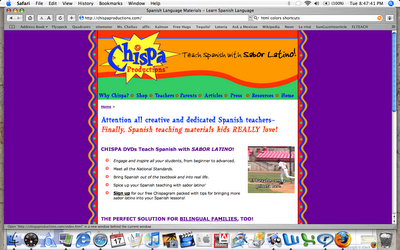
The wonderful creative genius behind this exciting new site is none other than the Web Muse herself, Anita Larson. Boy, did she and her amazing team of designers have to be patient with me. We went back and forth on the logo, the borders, the colors ... everything! (Those little green dots in the border? That was an entire day's worth of discussion with my husband and just about everyone else I knew...)
And then there was the moment of panic today when I accidentally erased my entire home page ... But Anita saved the day, and we were back online within the hour.
So click right on over to Chispa to check out what all the excitement is about ... and find some great tips for teaching Spanish with sabor latino!
Now, about that champagne ...
I am so excited with how it all came out!

The wonderful creative genius behind this exciting new site is none other than the Web Muse herself, Anita Larson. Boy, did she and her amazing team of designers have to be patient with me. We went back and forth on the logo, the borders, the colors ... everything! (Those little green dots in the border? That was an entire day's worth of discussion with my husband and just about everyone else I knew...)
And then there was the moment of panic today when I accidentally erased my entire home page ... But Anita saved the day, and we were back online within the hour.
So click right on over to Chispa to check out what all the excitement is about ... and find some great tips for teaching Spanish with sabor latino!
Now, about that champagne ...
Thursday, November 09, 2006
What happened to salsa?
I miss salsa.
Sure, there are now more salsa clubs and salsa classes and even salsa conferences than ever before.
But it's not the same salsa that I first knew. Somehow, salsa has lost its soul.
Back in the late 70s, when I was a college senior and Gloria Estefan was just one of the singers in a new band called "Miami Sound Machine", I learned how to dance salsa in the apartment of my Venezuelan friends. It was simple, and it was fun. Grab your partner, feel the beat, and move.
If you wanted to get fancy, maybe occasionally you and your partner would throw a turn in there. Or you could add that little extra beat with your foot ("la patita") before stepping into the next step.
But mostly, you wanted to feel the music and enjoy dancing with your partner. You could even chat while dancing. Either way – verbally or nonverbally – salsa was about communicating with your dance partner and enjoying the music.
Not so anymore.
Salsa has somehow become a competitive sport. How many turns can you do in one beat?? What's your signature flash move? Don't forget to throw your arm up in the air with a flourish every time you turn or step away from your partner! And do you dance on 1 or on 2?
Communicate with your partner? Enjoy the music? Not a chance. And converse? ¿Estás loco?
Give me old-style salsa any day ... and give salsa back its soul!
Sure, there are now more salsa clubs and salsa classes and even salsa conferences than ever before.
But it's not the same salsa that I first knew. Somehow, salsa has lost its soul.
Back in the late 70s, when I was a college senior and Gloria Estefan was just one of the singers in a new band called "Miami Sound Machine", I learned how to dance salsa in the apartment of my Venezuelan friends. It was simple, and it was fun. Grab your partner, feel the beat, and move.
If you wanted to get fancy, maybe occasionally you and your partner would throw a turn in there. Or you could add that little extra beat with your foot ("la patita") before stepping into the next step.
But mostly, you wanted to feel the music and enjoy dancing with your partner. You could even chat while dancing. Either way – verbally or nonverbally – salsa was about communicating with your dance partner and enjoying the music.
Not so anymore.
Salsa has somehow become a competitive sport. How many turns can you do in one beat?? What's your signature flash move? Don't forget to throw your arm up in the air with a flourish every time you turn or step away from your partner! And do you dance on 1 or on 2?
Communicate with your partner? Enjoy the music? Not a chance. And converse? ¿Estás loco?
Give me old-style salsa any day ... and give salsa back its soul!
Friday, November 03, 2006
¡Atrévete!
I just love this song ... it is so much fun!
The beat is infectious (just like the lyrics say) and the lyrics are just a riot – a pure celebration of Spanglish with a Puerto Rican accent. I love how they unhesitatingly rhyme "esmalte" with "taparte" and "retratarte!"
Take out the reference to nalgas and tapa rabo (not sure I want to explain the origin of that one to a class...) ... and I guess gloss over some of the other suggestive phrases if you have a young or sensitive class... and this would be a great song to teach informal commands, especially commands with reflexive pronouns. I've highlighted the commands below .... and hey, you've even got a matching negative reflexive command (Ponte and No te pongas), a command with both a reflexive and an object pronoun (súbetela), and some subjunctive to boot!
So what do you say, Spanish teachers? If this song is too risqué, then find another one ... but use popular music to make Spanish popular! ¡Salganse del closet, y atrévanse!
Atrévete, te, te, te
Salte del closet,
Destápate, quítate el esmalte
Deja de taparte que nadie va a retratarte
Levántate, ponte hyper
Préndete, sácale chispas al estárter
Préndete en fuego como un lighter
Sacúdete el sudor como si fueras un wiper
Que tú eres callejera, “Street Fighter”
Cambia esa cara de seria
Esa cara de intelectual, de enciclopedia
Que te voy a inyectar con la bacteria
Pa’ que des vuelta como machina de feria
Señorita intelectual, ya se que tienes
El área abdominal que va a explotar
Como fiesta patronal, que va a explotar
Como palestino…
Yo sé que a ti te gusta el pop-rock latino
Pero es que el reggaeton se te mete por los intestinos
Por debajo de la falda como un submarino
Y te saca lo de indio taino
Ya tú sabes, en tapa-rabo, mama
En el nombre de Agüeybana
No hay mas na’, para na’ que yo te vo’a mentir
Yo sé que yo también quiero consumir de tu perejil
Y tú viniste amazónica como Brasil
Tú viniste a matarla como “Kill Bill”
Tú viniste a beber cerveza de barril
Tú sabes que tú conmigo tienes refill
Atrévete, te, te, te
Salte del closet,
Destápate, quítate el esmalte
Deja de taparte que nadie va a retratarte
Levántate, ponte hyper
Préndete, sácale chispas al estárter
Préndete en fuego como un lighter
Sacúdete el sudor como si fueras un wiper
Que tú eres callejera, “Street Fighter”
Hello, deja el show
Súbete la mini-falda
Hasta la espalda
Súbetela, deja el show, más alta
Que ahora vamo’a bailar por to’a la jarda
Mira, nena, ¿quieres un sipi?
No importa si eres rapera o eres hippie
Si eres de Bayamón o de Guaynabo City
Conmigo no te pongas picky
Esto es hasta abajo, cógele el tricky
Esto es fácil, estoy es un mamey
¿Que importa si te gusta Green Day?
¿Que importa si te gusta Coldplay?
Esto es directo, sin parar, one-way
Yo te lo juro de que por ley
Aquí to’a las boricuas saben karate
Ellas cocinan con salsa de tomate
Mojan el arroz con un poco de aguacate
Pa’ cosechar nalgas de 14 quilates
Atrévete, te, te, te
Salte del closet,
Destápate, quítate el esmalte
Deja de taparte que nadie va a retratarte
Levántate, ponte hyper
Préndete, sácale chispas al estárter
Préndete en fuego como un lighter
Sacúdete el sudor como si fueras un wiper
Que tú eres callejera, “Street Fighter”
The beat is infectious (just like the lyrics say) and the lyrics are just a riot – a pure celebration of Spanglish with a Puerto Rican accent. I love how they unhesitatingly rhyme "esmalte" with "taparte" and "retratarte!"
Take out the reference to nalgas and tapa rabo (not sure I want to explain the origin of that one to a class...) ... and I guess gloss over some of the other suggestive phrases if you have a young or sensitive class... and this would be a great song to teach informal commands, especially commands with reflexive pronouns. I've highlighted the commands below .... and hey, you've even got a matching negative reflexive command (Ponte and No te pongas), a command with both a reflexive and an object pronoun (súbetela), and some subjunctive to boot!
So what do you say, Spanish teachers? If this song is too risqué, then find another one ... but use popular music to make Spanish popular! ¡Salganse del closet, y atrévanse!
Atrévete, te, te, te
Salte del closet,
Destápate, quítate el esmalte
Deja de taparte que nadie va a retratarte
Levántate, ponte hyper
Préndete, sácale chispas al estárter
Préndete en fuego como un lighter
Sacúdete el sudor como si fueras un wiper
Que tú eres callejera, “Street Fighter”
Cambia esa cara de seria
Esa cara de intelectual, de enciclopedia
Que te voy a inyectar con la bacteria
Pa’ que des vuelta como machina de feria
Señorita intelectual, ya se que tienes
El área abdominal que va a explotar
Como fiesta patronal, que va a explotar
Como palestino…
Yo sé que a ti te gusta el pop-rock latino
Pero es que el reggaeton se te mete por los intestinos
Por debajo de la falda como un submarino
Y te saca lo de indio taino
Ya tú sabes, en tapa-rabo, mama
En el nombre de Agüeybana
No hay mas na’, para na’ que yo te vo’a mentir
Yo sé que yo también quiero consumir de tu perejil
Y tú viniste amazónica como Brasil
Tú viniste a matarla como “Kill Bill”
Tú viniste a beber cerveza de barril
Tú sabes que tú conmigo tienes refill
Atrévete, te, te, te
Salte del closet,
Destápate, quítate el esmalte
Deja de taparte que nadie va a retratarte
Levántate, ponte hyper
Préndete, sácale chispas al estárter
Préndete en fuego como un lighter
Sacúdete el sudor como si fueras un wiper
Que tú eres callejera, “Street Fighter”
Hello, deja el show
Súbete la mini-falda
Hasta la espalda
Súbetela, deja el show, más alta
Que ahora vamo’a bailar por to’a la jarda
Mira, nena, ¿quieres un sipi?
No importa si eres rapera o eres hippie
Si eres de Bayamón o de Guaynabo City
Conmigo no te pongas picky
Esto es hasta abajo, cógele el tricky
Esto es fácil, estoy es un mamey
¿Que importa si te gusta Green Day?
¿Que importa si te gusta Coldplay?
Esto es directo, sin parar, one-way
Yo te lo juro de que por ley
Aquí to’a las boricuas saben karate
Ellas cocinan con salsa de tomate
Mojan el arroz con un poco de aguacate
Pa’ cosechar nalgas de 14 quilates
Atrévete, te, te, te
Salte del closet,
Destápate, quítate el esmalte
Deja de taparte que nadie va a retratarte
Levántate, ponte hyper
Préndete, sácale chispas al estárter
Préndete en fuego como un lighter
Sacúdete el sudor como si fueras un wiper
Que tú eres callejera, “Street Fighter”
Tuesday, October 31, 2006
Salud, amor y pesetas
¡Salud!

Un grupo de amigos, un vinito ....
Best friends and a good wine .... is there any better combination? Latin cultures have known this forever.
So it's no wonder that there are so many different ways to toast with friends in Spanish.
The simplest and most direct:
¡Salud!
But few are satisfied with that. So it is often expanded to:
¡Salud, amor y pesetas!
Good, but still not good enough. Sure, health, love and money are important, but you need something more ... and everyone has their own favorite variation of this theme:
Salud, amor y pesetas, y tiempo para gozarlos
Salud, amor y pesetas, y tiempo para gastarlos
Salud, amor y pesetas, y tiempo para gustarlos
Salud, amor y pesetas, y tiempo para disfrutarlos
(And by the way, how come that never got updated to Salud, amor y pesos, or Salud, amor y bolívares, or Salud, amor y colones?)
But my favorite bríndises are the ones I learned in college from a dear Venezuelan friend (and by the way, one constant in my life seems to be incredibly wonderful Venezuelan friends ... I'm going to have to blog some other time on what is either the amazing Venezuelan national character, or my amazing luck in finding such wonderful friends). But back to my point .... the toasts:
Pa' arriba
Pa' abajo
Pa'l centro
Pa' dentro!
.... and this treasure ....
Manjar de dioses,
Dulce tormento,
¿Qué haces afuera?
¡Vámonos pa' dentro!
Recently I wrote to my college friend and told him that I still remembered the toasts he taught me, more than 25 years later.
His response:
Estiro el brazo,
Empino el codo,
Y de un solo golpe,
Me lo tomo todo!!
Good friendships last forever, and that is certainly something to toast to.
Anyone else have a favorite bríndis to share? Add them to our comments .... and ¡salud!

Un grupo de amigos, un vinito ....
Best friends and a good wine .... is there any better combination? Latin cultures have known this forever.
So it's no wonder that there are so many different ways to toast with friends in Spanish.
The simplest and most direct:
¡Salud!
But few are satisfied with that. So it is often expanded to:
¡Salud, amor y pesetas!
Good, but still not good enough. Sure, health, love and money are important, but you need something more ... and everyone has their own favorite variation of this theme:
Salud, amor y pesetas, y tiempo para gozarlos
Salud, amor y pesetas, y tiempo para gastarlos
Salud, amor y pesetas, y tiempo para gustarlos
Salud, amor y pesetas, y tiempo para disfrutarlos
(And by the way, how come that never got updated to Salud, amor y pesos, or Salud, amor y bolívares, or Salud, amor y colones?)
But my favorite bríndises are the ones I learned in college from a dear Venezuelan friend (and by the way, one constant in my life seems to be incredibly wonderful Venezuelan friends ... I'm going to have to blog some other time on what is either the amazing Venezuelan national character, or my amazing luck in finding such wonderful friends). But back to my point .... the toasts:
Pa' arriba
Pa' abajo
Pa'l centro
Pa' dentro!
.... and this treasure ....
Manjar de dioses,
Dulce tormento,
¿Qué haces afuera?
¡Vámonos pa' dentro!
Recently I wrote to my college friend and told him that I still remembered the toasts he taught me, more than 25 years later.
His response:
Estiro el brazo,
Empino el codo,
Y de un solo golpe,
Me lo tomo todo!!
Good friendships last forever, and that is certainly something to toast to.
Anyone else have a favorite bríndis to share? Add them to our comments .... and ¡salud!
Monday, October 30, 2006
We need more Tommy Torres!
So many of my posts these days seem to be about music ....
But music is such an integral part of why I love Spanish, and Latin cultures, so it's not too surprising.
One of my favorite artists is Tommy Torres. He's often in the background, generously supporting other artists with his beautiful songs, guitar-playing and voice, and as a producer as well (for Ricardo Arjona, Ednita Nazario, Robi Draco Rosa, etc.).
Here he is with Julieta Venegas:
Julieta Venegas y Tommy Torres
But when he steps out front, wow ... es increíble, y me encanta. Check out both his albums, "Tommy Torres" and "Estar de moda no está de moda."
So given how much I admire Tommy Torres' music, I shouldn't have been surprised the other day when I heard Ricky Martin's new song, "Tu Recuerdo," on the radio and fell in love with it ... because when I looked up the video clip, who did I see in the background playing and singing, but Tommy Torres .... and who wrote the song? Tommy Torres.
Ricky Martin, Tommy Torres and La Mari
I'll definitely be buying the Ricky Martin MTV Unplugged album ... but I really hope Tommy Torres comes out with a third solo album soon. The world needs more of him out front, not just behind the scenes.
But music is such an integral part of why I love Spanish, and Latin cultures, so it's not too surprising.
One of my favorite artists is Tommy Torres. He's often in the background, generously supporting other artists with his beautiful songs, guitar-playing and voice, and as a producer as well (for Ricardo Arjona, Ednita Nazario, Robi Draco Rosa, etc.).
Here he is with Julieta Venegas:
Julieta Venegas y Tommy Torres
But when he steps out front, wow ... es increíble, y me encanta. Check out both his albums, "Tommy Torres" and "Estar de moda no está de moda."
So given how much I admire Tommy Torres' music, I shouldn't have been surprised the other day when I heard Ricky Martin's new song, "Tu Recuerdo," on the radio and fell in love with it ... because when I looked up the video clip, who did I see in the background playing and singing, but Tommy Torres .... and who wrote the song? Tommy Torres.
Ricky Martin, Tommy Torres and La Mari
I'll definitely be buying the Ricky Martin MTV Unplugged album ... but I really hope Tommy Torres comes out with a third solo album soon. The world needs more of him out front, not just behind the scenes.
Friday, October 13, 2006
Te Mando Flores - from Colombia to the U.S.
It often seems as if in today's world, we have instant access to everything ... a click of a mouse, and you can find whatever you want.
That wasn't my experience, though, when I had lunch with some friends visiting from Colombia back in the fall of 2004. We were discussing music, and they told me about a great new singer named Fonseca.

Fonseca
Of course, I went home and got to work. I searched Google, iTunes, Amazon .... EVERYTHING!
No Fonseca.
I kept trying every few months, but still ... no Fonseca.
I asked my friend Liz to look for a Fonseca CD when she went to Venezuela .... but no Fonseca there, either.
I kept trying.
The next summer (2005), Liz returned to Venezuela. I got a call from her saying, "You know that Fonseca? They're playing his video all over the television here!" She still couldn't find the CD to buy, but she was able to download a few songs and brought them to me.
I finally had my Fonseca! And yes, he was great! He has a warm and engaging voice, beautiful lyrics, catchy vallenato-based music ... a total delight.
But why wasn't he in the U.S.?
I kept looking to see when, if ever, this incredibly talented artist was going to show up in the U.S. market.
Well, it took two full years, but he's here!
And not only is he here, but he's nominated for two 2006 Latin Grammys: Record of the Year and Best Tropical Song.
Best of luck to Fonseca ... it took long enough, but I'm glad he's here! And I hope his success means that it won't take two years for his next CD to get from Colombia to the US. He's worth the wait, but I prefer instant gratification.
That wasn't my experience, though, when I had lunch with some friends visiting from Colombia back in the fall of 2004. We were discussing music, and they told me about a great new singer named Fonseca.

Fonseca
Of course, I went home and got to work. I searched Google, iTunes, Amazon .... EVERYTHING!
No Fonseca.
I kept trying every few months, but still ... no Fonseca.
I asked my friend Liz to look for a Fonseca CD when she went to Venezuela .... but no Fonseca there, either.
I kept trying.
The next summer (2005), Liz returned to Venezuela. I got a call from her saying, "You know that Fonseca? They're playing his video all over the television here!" She still couldn't find the CD to buy, but she was able to download a few songs and brought them to me.
I finally had my Fonseca! And yes, he was great! He has a warm and engaging voice, beautiful lyrics, catchy vallenato-based music ... a total delight.
But why wasn't he in the U.S.?
I kept looking to see when, if ever, this incredibly talented artist was going to show up in the U.S. market.
Well, it took two full years, but he's here!
And not only is he here, but he's nominated for two 2006 Latin Grammys: Record of the Year and Best Tropical Song.
Best of luck to Fonseca ... it took long enough, but I'm glad he's here! And I hope his success means that it won't take two years for his next CD to get from Colombia to the US. He's worth the wait, but I prefer instant gratification.
Saturday, October 07, 2006
¡Abrazos!
This has nothing to do with Spanish ... unless you count the fact that many Latinos cultures seem to know this innately ... but it puts a smile on my face every time I see it, so I'm sharing it here:
¡Un fuertísimo abrazo para todos!
¡Un fuertísimo abrazo para todos!
Thursday, September 28, 2006
Which language should your child take?

Which language should your child take?
As a Spanish teacher, I’m always being asked for recommendations about which language a child should take.
This frequently comes up when children are moving up from elementary school – where in many cases, Spanish is the only language offered ¬ to middle school, where they actually have a choice for the first time. And this is what I often hear:
“Joey want to take French, but I think he should keep taking Spanish. I mean, he’s been learning Spanish since kindergarten, and it’s such a useful language ....”

To which I reply ....
Joey should take whatever language he wants!
Parents are almost always surprised by my response, especially since I am a Spanish teacher. And in fact, there are a number of language experts who disagree with me as well. Neither one likes to see what was learned in elementary school “wasted” if the child moves on to another language.
But to me, language is about a passion to communicate, a connection to the people, a love for the sound and feeling of the language, an interest in the culture and the countries where the language is spoken.
So as much as possible, you should be studying the language that appeals to YOU.
I don’t want people in my Spanish classes because they think it’s useful or – even worse – that it’s easy. (Hello?? Por vs. para? Ser vs. estar? A gazillion irregular verbs? Subjunctive????)

I want students who want to learn Spanish because they love it, because they love the sound of it, the culture, the music, the people, the poetry, the history, the literature ....
Certainly, we as teachers will always strive to bring that excitement into our classrooms and instill that love in all students. But sometimes, as in any relationship, the heart is elsewhere.
In languages, as in love, el corazón tiene razones que la razón desconoce. The heart has its reasons that reason knows nothing of.

But what about those “wasted” years, the time spent on another language that would be abandoned if a child moves on to another language?
No te preocupes. Don’t worry. I don’t believe any of that time, or any of that language learning, is wasted. In languages, anything that you have already learned will enhance what you study in the future. Even if it’s a different language, you are still programming your mind to learn different vocabulary, different sentence structures, and different ways of expressing things. And anything that you study in the future will reinforce what you have already learned – “Oh yes, that’s like what I learned in Spanish,” or “Oh, that’s different from the way you say it in Spanish.”

To reinforce my point, I always point out to parents – whose children, in most cases, started learning Spanish in kindergarten – that I didn’t learn a word of Spanish until 11th grade. I took Latin for four years, and then started Spanish (and the following year, added Italian). And even I, with my very self-critical manner, will say that I am near-native fluent now.
How and why did I become fluent? Because I loved the language, the culture, the people, the music, the food, the poetry, the literature .... all of it. Because I followed my heart and my interests and my passion.
So, which language should your child take?
Ask your child.
Subscribe to:
Posts (Atom)